The reliable rule: Store the battery according to its own manual in a dry, room-temperature place where its terminals cannot contact metal and the pack cannot be crushed, dropped, or heated. There is no defensible universal instruction that every power-tool battery must sit at exactly 40% to 60% charge.
That percentage is often repeated without a model-specific source. Battery electronics, charger behavior, chemistry, and manufacturer instructions differ. The safer approach is to follow the exact pack and charger documentation, then use the shared precautions below.
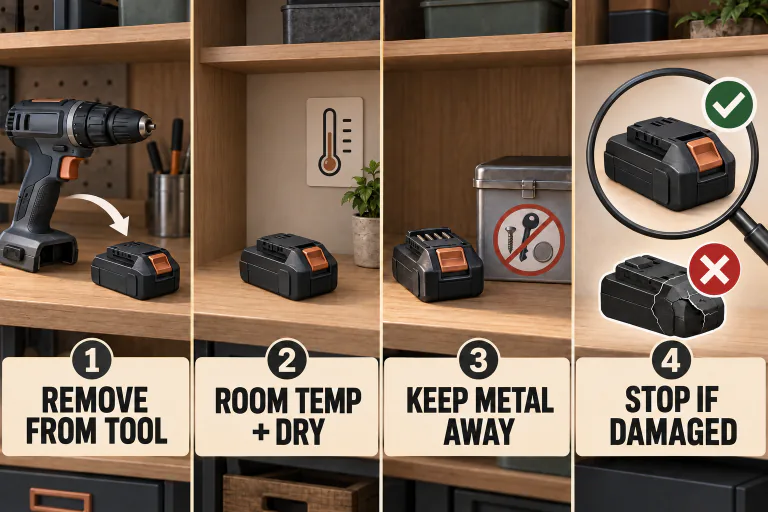
The five-step storage routine
- Let a recently used pack return to normal room temperature.
- Remove a detachable battery from the tool before long storage.
- Keep the pack dry, out of direct sun, and away from extreme heat or cold.
- Protect the terminals from screws, keys, nails, coins, and other conductive objects.
- Check the pack and its manual before the next season or project.
This routine handles the hazards that manufacturer manuals and U.S. battery guidance consistently emphasize without inventing a charge target that may not apply to the pack in front of you.
Charge level: use the manual, not a universal percentage
Some battery makers publish a preferred long-storage state of charge; others focus on temperature, approved chargers, and avoiding damage or short circuits. That difference matters.
For example, the current Bosch PS31 manual tells owners to use approved chargers, keep batteries away from metal when they are outside the tool or charger, charge within the specified temperature range, and store the tool and pack where temperatures will not exceed 120 degrees F. It does not tell the owner to meter the pack to a universal 40% to 60% target.
Use this decision order:
- If the manual specifies a storage charge range, follow it.
- If the charger has an explicit storage or maintenance mode, follow that charger’s instructions.
- If neither provides a percentage, do not estimate state of charge from a vague fuel gauge and present it as precision.
- Check a long-stored pack periodically so it is not forgotten for an entire year.
This is less catchy than one internet percentage, but it is more accurate across mixed-brand workshops.
Temperature matters more than the garage label
“Garage storage” is not one condition. An insulated garage in a mild climate and a metal shed in direct summer sun create completely different battery environments.
The U.S. EPA’s lithium-ion battery FAQ recommends room-temperature storage and avoiding long periods of extreme cold or heat, including a vehicle dashboard in direct sunlight. The Bosch manual gives an exact ceiling for its covered tool and battery: a storage location that does not exceed 120 degrees F.
DEWALT’s current battery-safety guidance likewise says to store and charge batteries in a cool, dry location and avoid liquids and extreme temperatures.
Use the more restrictive instruction in the exact manual. An indoor utility shelf often beats a garage cabinet when the garage freezes in winter or becomes very hot in summer.
Avoid:
- vehicle cabins and trunks
- sunny windowsills
- shelves above heaters or boilers
- damp floors and flood-prone basement corners
- unventilated sheds with large temperature swings
Do not put a lithium-ion pack in a refrigerator or freezer. EPA says room temperature is the appropriate baseline.
Keep loose metal away from the terminals
A battery does not need to be connected to a tool to create a short-circuit risk. Bosch’s manual specifically warns against storing loose packs in a toolbox or pocket with nails, screws, keys, or similar metal objects. PHMSA likewise requires terminal protection when lithium batteries are prepared for transport.
For an in-service pack on a workshop shelf:
- keep it in the original case, a purpose-built holder, or a separate nonconductive compartment
- do not drop loose hardware into the same bin
- do not stack heavy tools where they can damage the housing or contacts
- use a manufacturer-supplied terminal cover when one exists
Terminal tape and individual plastic bags are especially relevant when a pack is being taken for recycling. For ordinary reusable storage, do not cover vents, labels, sensors, or features unless the manufacturer directs it.
Remove the battery from the tool for long storage
Bosch’s general power-tool safety instructions say to remove a detachable battery before storing the power tool. That reduces accidental activation and separates the pack from a tool that could be damaged, bumped, or left with its switch vulnerable.
For a short break between jobs, follow the tool manual and use the switch lock where provided. For seasonal storage, separate tool and pack is the cleaner default when the battery is designed to be removed.
This also makes inspection easier. You can see cracks, damaged rails, contaminated contacts, or a housing that no longer sits flat before the next use.
Should the battery stay on the charger?
Do not treat every charger as a maintenance charger. Some chargers are designed to manage a connected pack after charging; others provide different instructions. The correct answer lives in the exact charger manual.
Before leaving a pack connected for weeks, confirm:
- the charger model is approved for that battery
- its manual permits extended connection
- ventilation openings remain clear
- the charger sits on a stable surface away from combustible material
- the storage temperature is inside the charger’s allowed range
If the documentation is unclear, disconnecting the charged pack and checking it later is more defensible than assuming indefinite connection is harmless.
A seasonal check that takes two minutes
Inspect stored packs at the start and end of a long idle period.
| Check | Healthy sign | Stop-and-escalate sign |
|---|---|---|
| Housing | Flat, intact, and clean | Swelling, cracks, melting, puncture, or deformation |
| Terminals | Dry and unobstructed | Burn marks, corrosion, embedded metal, or physical damage |
| Temperature | Normal after sitting | Unexplained warmth or heat |
| Fit | Slides and latches normally | Binding, forced fit, or damaged rails |
| Charging | Charger reports normal operation | Repeated fault indication, smoke, odor, or unusual heat |
Do not open or attempt to rebuild a damaged pack. The Bosch manual says damaged battery packs should be serviced only by the manufacturer or authorized providers.
If a lithium-ion battery is swollen or physically damaged, EPA advises contacting the manufacturer, retailer, state waste agency, or local household hazardous-waste program for direction. If there appears to be an imminent fire threat, leave the area and contact emergency services.
Storage advice changes with battery chemistry
Power tools can use lithium-ion, nickel-cadmium, nickel-metal hydride, and lead-acid batteries. Do not identify chemistry from housing color or tool brand.
Read the pack label and manual. A modern slide pack marked Li-ion should not inherit instructions for an old nickel-cadmium pack. A riding-mower starting battery is often lead-acid and needs a different maintenance plan from a detachable lithium-ion drill battery.
That distinction matters on Toolforge. Our CRAFTSMAN CMCD700C1 drill review covers a removable lithium-ion V20 pack. Our Cub Cadet XT1 LT42 guide discusses a 12-volt AGM mower battery. Do not apply one article’s charger or storage procedure to the other chemistry.
Do not buy another platform because a battery was stored badly
Storage problems can disguise a buying problem. If a drill routinely sits unused, the issue may be that its battery system is too large, heavy, or inconvenient for the jobs you actually do.
Before replacing a failed or neglected pack, ask:
- Do I use enough tools in this battery family to justify another pack?
- Would a smaller 12V system leave the shelf more often?
- Does a corded tool make more sense for stationary work?
- Am I about to spend more on batteries than a complete current kit costs?
Our 12V versus 18V drill guide turns those questions into a concrete buyer decision. The cheapest replacement battery is not good value when it preserves the wrong platform.
Recycling an end-of-life pack
Lithium-ion tool batteries do not belong in household trash or curbside recycling. EPA says to take them to a separate battery-recycling or household hazardous-waste collection point.
For transport to an approved collection location:
- follow the recycler’s acceptance instructions
- protect terminals with nonconductive tape or place each battery in its own plastic bag, as EPA directs
- prevent the pack from shifting or being crushed
- tell the facility if the pack is damaged, swollen, recalled, or hot
The EPA used-battery guide links to recycling resources and explains why even apparently discharged batteries need separate handling.
Quick checklist
- Identify the battery chemistry and exact model.
- Read both the battery/tool manual and charger manual.
- Use the manufacturer’s storage charge instruction if one exists.
- Store at room temperature when practical and inside the exact model’s limits.
- Keep the pack dry and out of direct sunlight.
- Remove a detachable pack from the tool for long storage.
- Keep terminals away from loose metal.
- Do not assume every charger supports indefinite connection.
- Inspect before reuse; stop on swelling, cracks, heat, odor, or charger faults.
- Recycle end-of-life rechargeable batteries through an approved collection path.
Sources checked
See Also
If you want to move from general advice into actual product choices, start with What Size Torque Wrench Case Fits Your Tool Bag?, Torque Wrench for Beginners Buying Guide, and How to Use a Table Saw Safely.
For a wider picture after the basics, Electric vs. Gas Pressure Washer: Which Is Better for Homeowners? and California Air Tools 10020C Air Compressor Review are the next places to read.